
How Football AI Works: From Match Data to Tactical Insights
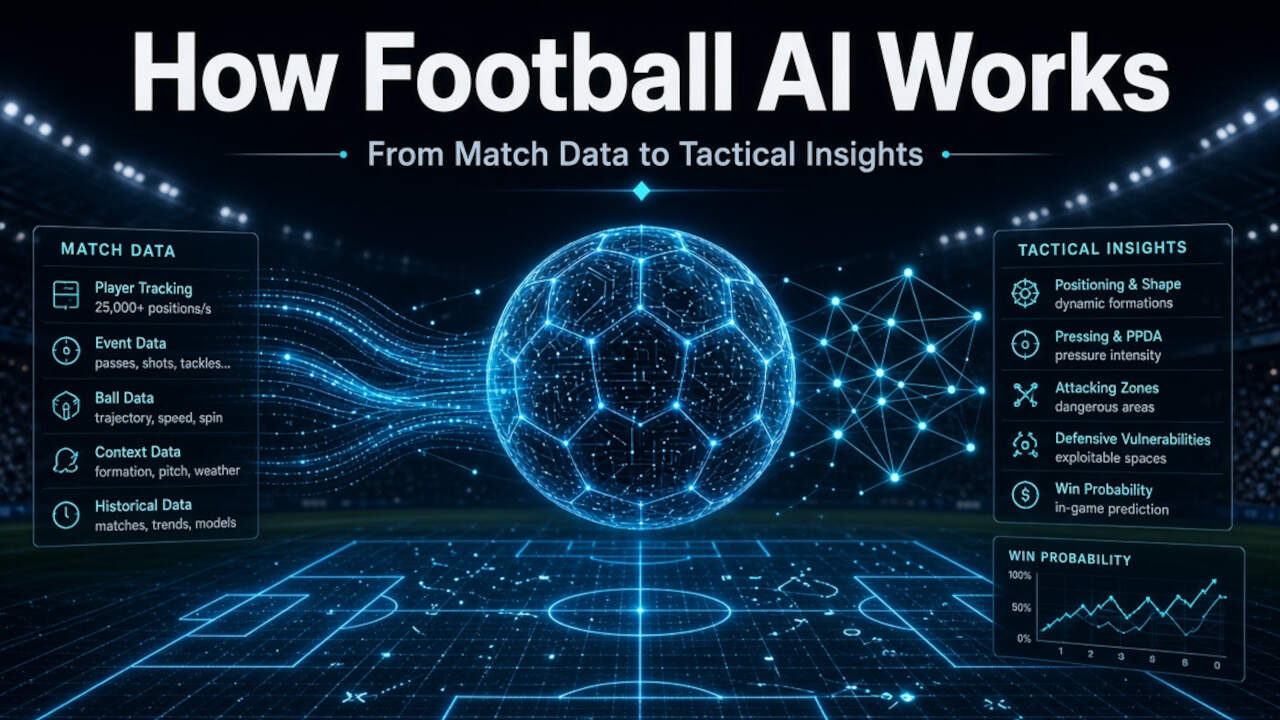
Football AI can seem complicated when it is described through terms such as machine learning, computer vision, predictive models and tracking data. In practice, the basic idea is easier to understand.
Football AI takes large amounts of football data, processes that data, identifies patterns and produces information that can support decisions.
A simplified football AI pipeline looks like this:
Data → Processing → Models → Analysis → Insights → Decisions
This process can be applied to match analysis, player scouting, tactical analysis, performance monitoring, recruitment and match prediction.
In this guide, we explain how football AI works step by step and how raw football data becomes useful information for coaches, analysts, scouts and clubs.
What Is Football AI?
Football AI refers to the use of artificial intelligence and related technologies to analyze football data and generate useful insights.
The data can come from many sources, including match events, player tracking systems, video footage, historical results and player statistics.
Football AI can then use techniques such as machine learning, computer vision and statistical modeling to identify patterns that may be difficult to detect manually.
For example, an AI system may analyze:
- Player movements
- Passing patterns
- Shots and goals
- Possession sequences
- Defensive actions
- Team formations
- Physical performance
- Historical match results
- Player statistics
- Video footage
The goal is not simply to collect more data. The important step is turning that data into information that can help people understand what is happening on the pitch.
You can explore the broader landscape through Football & Soccer and Football Analysis, Data & Scouting.
1. Collecting Football Data
The first stage of football AI is data collection.
An AI model cannot analyze football without data. The quality, quantity and structure of that data have a major impact on what the system can produce.
Football data can generally be divided into several types.
Event Data
Event data records actions that happen during a match.
Examples include:
- Passes
- Shots
- Goals
- Tackles
- Interceptions
- Fouls
- Crosses
- Dribbles
- Clearances
- Cards
Each event can also contain additional information such as the location on the pitch, the player involved, the time of the event and the outcome.
For example, a pass can be represented as a structured event containing:
- Passing player
- Receiving player
- Starting location
- Ending location
- Match time
- Pass outcome
This structured information gives an AI system a foundation for analyzing how teams and players behave.
Resources such as StatsBomb and API-Football illustrate how structured football data can be used as part of a broader football analysis workflow.
Tracking Data
Tracking data provides information about player and ball positions over time.
Instead of recording only individual events, a tracking system can represent where players are located throughout a match.
A simplified example might look like:
Time: 32:14

Player A: (42, 31)
Player B: (55, 28)
Player C: (61, 44)
Ball:    (57, 35)
Repeating this process many times per second creates a detailed representation of movement.
Tracking data can help analyze:
- Player positioning
- Team shape
- Running patterns
- Defensive compactness
- Space creation
- Pressing behavior
- Off-ball movement
- Distance covered
Companies and platforms such as SkillCorner, KINEXON Sports and Catapult One are examples of technologies within the wider football tracking and performance ecosystem.
Video Data
Football video contains even more information than traditional event data, but it is much harder for computers to interpret.
A video consists of a sequence of images. Computer vision systems can process these images to identify objects, players and movement.
A system may attempt to detect:
- Players
- Ball position
- Pitch boundaries
- Player movement
- Team identity
- Body orientation
- Events occurring during play
This allows AI systems to extract structured information from video that can later be used for analysis.
2. Turning Raw Data Into Usable Information
Raw football data is rarely ready to be used directly by an AI model.
Before analysis, the data normally needs to be cleaned, organized and transformed.
This process can include:
- Removing duplicate records
- Handling missing values
- Standardizing player names
- Correcting timestamps
- Normalizing coordinates
- Converting different data formats
- Connecting events with players and matches
Consider two datasets that describe the same player differently:
Dataset A: Jude Bellingham
Dataset B: J. Bellingham
An analysis system needs to understand that these records refer to the same player.
The same principle applies to teams, competitions, matches and event types.
Data preparation is therefore an important part of football AI. A sophisticated model cannot compensate for fundamentally unreliable or poorly structured input data.
3. Teaching Models to Recognize Patterns
Once the data has been prepared, machine learning models can be used to identify patterns.
Traditional software generally follows explicit rules:
IF condition A happens
THEN perform action B
Machine learning works differently.
Instead of defining every possible rule manually, developers provide the model with data and allow it to learn relationships within that data.
For example, a model could analyze thousands of historical passing sequences and learn which characteristics are associated with successful progression.
The model does not simply memorize one specific pass.
It attempts to identify relationships between variables.
These variables might include:
- Player positions
- Distance to opponents
- Passing angle
- Available space
- Number of nearby players
- Previous actions
- Team positioning
The resulting model can then be applied to new situations.
4. Supervised Learning in Football
One common machine learning approach is supervised learning.
In supervised learning, a model is trained using examples where the desired outcome is already known.
Imagine a dataset containing thousands of shots.
Each record could contain:
Shot location
Shot angle
Distance to goal
Number of defenders
Body part used
Previous action
Outcome
The outcome might indicate whether the shot resulted in a goal.
During training, the model searches for relationships between the input variables and the known outcomes.
After training, the model can evaluate new shots.
This type of approach can be used for many football problems, including:
- Shot outcome estimation
- Pass outcome analysis
- Player evaluation
- Match outcome modeling
- Recruitment analysis
However, the quality of the result depends heavily on the training data and how the problem is defined.
5. Computer Vision and Football Video
Computer vision is particularly important when football AI needs to understand video.
A computer does not naturally see a football match in the same way a human does.
Instead, video is processed as images and numerical information.
A simplified computer vision pipeline could look like:
Video
  ↓
Frame extraction
  ↓
Object detection
  ↓
Player and ball identification
  ↓
Tracking
  ↓
Event recognition
  ↓
Structured football data
The system can process individual frames and connect information across frames.
For example, if a player is detected in consecutive frames, the system can estimate how that player's position changes over time.
This can eventually produce tracking information that can be used for tactical or performance analysis.
Computer vision can also support automated recognition of football events, although the complexity of the task varies significantly depending on the event and the quality of the video.
6. AI for Tactical Analysis
Football tactics are highly dependent on space, positioning and movement.
This makes tracking and event data particularly useful for tactical analysis.
AI can process large numbers of observations to identify recurring patterns in team behavior.
For example, analysis might examine:
- How a team builds from the back
- Where a team creates overloads
- How wide players position themselves
- How a defensive line moves
- How a team presses
- Where space appears during transitions
- How players react after losing possession
A human analyst may recognize some of these patterns by watching matches.
AI can help process the same type of information across many matches and large datasets.
The resulting output can then be used as a starting point for deeper tactical analysis.
For broader football analytics resources, see Football Analysis, Data & Scouting.
7. AI for Player Scouting
Player scouting is another important application of football AI.
A scout may need to evaluate hundreds or thousands of players across different leagues.
AI can help reduce the amount of data that needs to be manually reviewed.
A scouting model might compare players using variables such as:
- Position
- Age
- Playing time
- Passing
- Ball progression
- Defensive actions
- Shooting
- Possession involvement
- Physical performance
The system can then identify players whose statistical profiles match a particular requirement.
For example, a club searching for a midfielder may define a profile based on:
Position: Central midfielder
Age: 18–23
Strong progression
High passing volume
Defensive contribution
Regular playing time
The model can search a large player database for candidates matching those characteristics.
Platforms such as Comparisonator, SciSports, DataMB, TransferRoom and Driblab represent different approaches within the broader football scouting, recruitment and player analysis ecosystem.
AI does not eliminate the need for scouting expertise. Instead, it can help scouts organize information and identify players for further investigation.
8. AI for Player Performance
Football AI can also be applied to player performance.
Performance analysis can combine match events, tracking information and physical measurements.
For example, a performance system may analyze:
- Distance covered
- High-speed running
- Sprinting
- Accelerations
- Decelerations
- Positioning
- Match workload
- Repeated actions
The same information can be analyzed across multiple matches to identify changes over time.
A player's performance profile might therefore become a time series:
Match 1 → workload
Match 2 → workload
Match 3 → workload
Match 4 → workload
Match 5 → workload
AI models can then search for patterns within these observations.
This can support areas such as performance monitoring, workload analysis and player development.
Related technologies can be found in Football Performance & Tracking and Sports Performance & Tracking.
9. AI for Match Prediction
Prediction is another widely discussed application of football AI.
A prediction model can use historical data to estimate the probability of different outcomes.
Potential inputs include:
- Previous results
- Team performance
- Home and away records
- Goals scored
- Goals conceded
- Player availability
- Recent form
- Match statistics
- Historical team data
A simplified prediction process could look like:
Historical matches
       ↓
Feature extraction
       ↓
Machine learning model
       ↓
Probability estimates
       ↓
Match prediction
For example, a model might produce probabilities such as:
Home win: 45%
Draw:     30%
Away win: 25%
These numbers should be interpreted as model outputs rather than guarantees.
Football contains significant uncertainty. A red card, injury, tactical change or individual error can change the outcome of a match.
You can explore this area through Football Predictions & Match Forecasting.
10. What Is Machine Learning Actually Learning?
One of the most important concepts to understand is that machine learning does not automatically understand football in the same way a coach does.
A model works with representations of football.
For example, it may receive variables such as:
x1 = player position
x2 = opponent distance
x3 = pass angle
x4 = available space
x5 = previous action
x6 = team possession state
The model searches for relationships between these variables and the target it is designed to predict.
In mathematical terms, the system is trying to approximate a relationship between inputs and outputs:
Input data → Model → Output
The output could be:
- A probability
- A classification
- A ranking
- A predicted value
- A detected event
- A recommended group of players
This distinction matters because the model's understanding is limited by its data and objective.
If the training data does not represent a particular situation well, the model may perform poorly when it encounters that situation.
11. From Prediction to Decision Support
The final purpose of football AI is usually not the prediction itself.
The useful part is what people can do with the information.
Consider player recruitment.
A model may identify 50 players with similar statistical profiles.
That does not mean the club should automatically sign one of them.
Instead, the output can become one input into a broader recruitment process.
The workflow might look like:
AI analysis
    ↓
Candidate identification
    ↓
Scout review
    ↓
Video analysis
    ↓
Tactical evaluation
    ↓
Background assessment
    ↓
Recruitment decision
This is why football AI is often better understood as decision support rather than decision replacement.
The model processes information at scale, while football professionals provide context and judgment.
12. Why Context Matters in Football AI
Football data can look objective because it consists of numbers.
However, numbers still require context.
Consider two midfielders who both complete a similar number of passes.
Their roles could be completely different.
One might play primarily sideways passes in a possession-oriented team.
Another might attempt progressive passes under heavy defensive pressure.
The same statistic can therefore represent different football situations.
Context can include:
- Team tactics
- League level
- Position
- Playing role
- Match state
- Opponent quality
- Teammates
- Managerial instructions
- Minutes played
Good football AI systems need to account for these factors when the analysis requires them.
This is also why comparing players or teams using a single statistic can produce misleading conclusions.
13. Football AI Is a Combination of Technologies
Football AI is not one technology.
It is an ecosystem that combines multiple technologies and data sources.
A modern football intelligence workflow may include:
Data Collection
Collecting match events, tracking information, video and other football data.
Data Engineering
Cleaning, transforming and organizing large datasets.
Machine Learning
Identifying patterns and building predictive or classification models.
Computer Vision
Extracting information from images and video.
Natural Language Processing
Processing written reports, documents or other textual information where appropriate.
Statistical Modeling
Quantifying relationships, probabilities and performance indicators.
Visualization
Turning complex datasets into information that coaches, analysts and scouts can understand.
These components can work together.
For example:
Video
  ↓
Computer Vision
  ↓
Tracking Data
  ↓
Data Processing
  ↓
Machine Learning
  ↓
Tactical Analysis
  ↓
Visualization
  ↓
Human Decision
This combination is what makes modern football intelligence systems powerful.
14. What Are the Limitations of Football AI?
Football AI has important limitations.
Data Quality
Poor-quality data can produce unreliable results.
Missing records, inconsistent definitions or inaccurate tracking can affect model performance.
Limited Training Data
A model can only learn from the examples available to it.
Rare tactical situations may be difficult to model accurately.
Changing Football
Football evolves.
Teams change managers, formations and playing styles.
A model trained on historical data may therefore need to be updated as football changes.
Correlation Does Not Always Mean Causation
AI can identify relationships in data without proving why those relationships exist.
For example, a statistic may be strongly associated with successful teams without being the direct cause of success.
Human Context
A model may not fully understand factors that are difficult to encode as data.
These can include tactical instructions, dressing-room dynamics, individual circumstances and other contextual information.
For these reasons, AI outputs should generally be interpreted alongside football expertise rather than treated as unquestionable answers.
15. How Coaches and Analysts Use AI
The practical workflow for coaches and analysts often starts with a specific question.
For example:
How did our team create chances against a low defensive block?
The analyst can then identify relevant data.
This could include:
- Possession sequences
- Player positions
- Passing locations
- Final-third entries
- Shot locations
- Defensive shape
AI can process large amounts of this information and identify recurring patterns.
The analyst can then review the results and connect them with video.
A simplified workflow is:
Football question
       ↓
Data collection
       ↓
AI analysis
       ↓
Pattern identification
       ↓
Video review
       ↓
Football interpretation
       ↓
Coaching decision
This approach combines computational scale with human football knowledge.
Football AI in Practice
The football technology landscape includes tools covering different parts of this workflow.
For data access and match information, resources such as Football-Data.co.uk, Football-Data.org, Sofa Score and FotMob provide examples of football data and match-information products.
For advanced analysis, scouting and performance workflows, platforms such as Impect, Metrica Sports, Hudl Wyscout and Nacsport illustrate how football technology can support analysis and video-based workflows.
These products do not necessarily perform the same job. The football AI ecosystem is made up of different layers, from data collection and match information to tracking, video analysis, scouting and performance analysis.
The Future of Football AI
As football data becomes more detailed, AI systems can work with increasingly complex representations of the game.
The direction of development is moving beyond simple statistics toward richer models of football situations.
Instead of asking only:
How many passes did a player complete?
Future analysis can increasingly consider questions such as:
Where was the player positioned?
What options were available?
How did opponents react?
What space was created?
What happened after the action?
This represents a shift from isolated statistics toward contextual football intelligence.
The combination of event data, tracking data, video and machine learning can provide a more complete picture of what happens during a match.
At the same time, human expertise remains important because football decisions involve context that cannot always be represented in a dataset.
How Football AI Works: The Simple Version
The entire process can be summarized in a few steps:
1. Collect Data
Football AI starts with data from matches, players, tracking systems and video.
2. Clean and Structure the Data
Raw information is transformed into consistent, usable datasets.
3. Train or Apply Models
Machine learning, statistical models and computer vision systems process the data.
4. Detect Patterns
The system identifies relationships, behaviors, probabilities or recurring situations.
5. Generate Insights
The results are converted into information that football professionals can understand.
6. Support Decisions
Coaches, analysts, scouts and clubs combine AI-generated information with football knowledge and context.
In simple terms:
Football AI does not replace football knowledge. It helps turn large amounts of football data into information that people can use.
That is the fundamental idea behind football AI, whether the application is Football Analysis, Data & Scouting, Scouting & Recruitment, Player Development & Assessment or Sports Data & Analytics.
If you want to understand the broader concept first, read What Is Football AI? How Artificial Intelligence Is Changing Football. For a broader look at applications, see How AI Is Used in Football: Analytics, Scouting, Tactics and More.